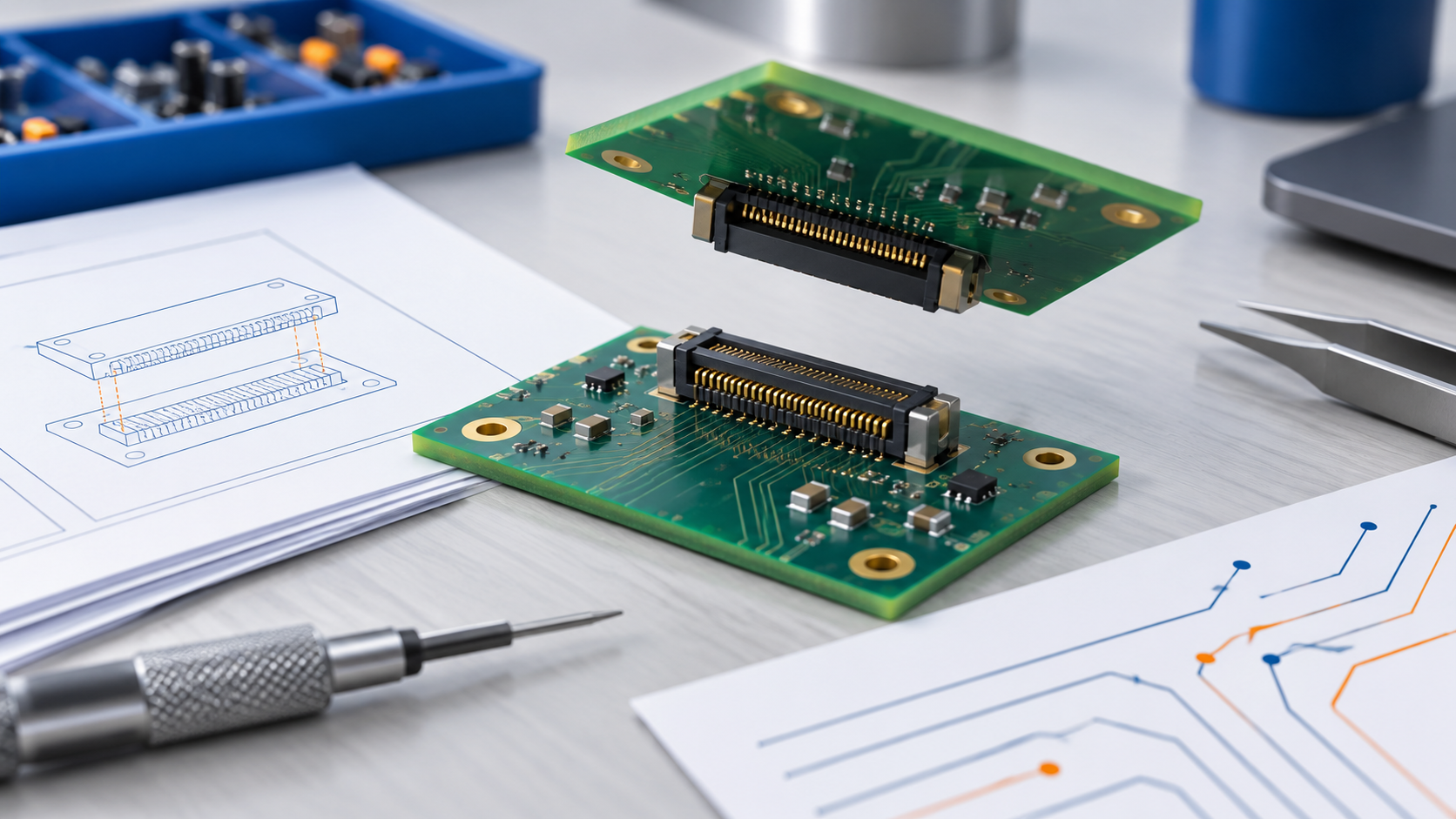
Summary. A board-to-board connector can be correctly identified yet still enter assembly with an uncontrolled footprint or an incomplete mating record. For Hirose DF40HC(3.0)-100DS-0.4V(51), this checklist organizes the handoff between component selection, PCB layout, assembly and incoming inspection. It uses the exact manufacturer identity and current first-party documents as evidence anchors; it does not release a PCB library, mating combination, production process or substitute.
1. Freeze the full orderable identity
Begin with the EPPTC DF40HC(3.0)-100DS-0.4V(51) product record. Preserve the height notation, contact-count field and packaging suffix in the BOM and enquiry. The Hirose exact-part record CL0684-4151-0-51 identifies a receptacle with 100 positions, 0.4 mm contact pitch, SMT mounting and a 3 mm mated height. Those are source-bound catalogue facts, not a completed design decision.
Record the exact manufacturer number, internal catalogue reference, source URL and reviewed document revision together. If a label omits a closing parenthesis or abbreviates the suffix, reconcile it against the controlled orderable identity before receiving or ordering. Keep nearby DF40 variants as separate records rather than treating their names as interchangeable.
2. Turn interface facts into layout evidence
A layout handoff should distinguish the connector body, the recommended land pattern and the complete mated assembly. Have the responsible designer obtain the exact drawing and compare pad geometry, orientation, pin-one marking, keep-outs, board tolerances and enclosure clearance with the released PCB library. Record which drawing revision generated the footprint and retain the independent library review.
The Hirose DF40 series catalogue helps locate the relevant configuration among several height and contact-count variants. Use it to organize the search, then confirm the exact row and applicable drawing. A shared pitch or an apparently matching contact count does not prove that another connector or footprint is suitable. Record the intended mating component by its full manufacturer number and review both interface records.
3. Keep assembly instructions under revision control
Consult the Hirose DF40 Series Guideline as the first-party assembly-reference entry. The production packet should identify the applicable instruction, file revision and part scope before settings are entered in the manufacturing system. Avoid extracting a process value from a photograph, search excerpt or an unrelated family example. If the relevant instruction cannot be matched to the configuration, leave that field open.
Assign ownership for PCB-library review, assembly-process validation and finished-board inspection. Keep manufacturer document conditions alongside each adopted requirement, and retain the actual project decision separately. This article supplies a documentation workflow; an automated completeness check cannot approve a soldering profile, fixture, electrical load or finished application. A successful sample assembly is evidence to review rather than automatic authority to release every subsequent batch.
4. Build a receiving and change-control packet
Incoming inspection should first connect the physical package to the complete orderable number and the purchase record. Capture label identity, lot or packaging traceability when supplied, visible damage and the disposition of uncertain material. Do not turn a marketplace image into an acceptance drawing. Price, available quantity and lead time belong in the current commercial reply, with its validity, rather than in the technical specification.
For a proposed alternate, use a separate comparison and change record. Compare the exact identity, contact layout, mounting geometry, plating information, mating evidence, document revisions and process scope. Name unresolved differences and their owner. A supplier description such as “equivalent” should initiate a review, not overwrite the released BOM. Keep the original requirement and the evidence used for the final project decision.
5. FAQ for the design handoff
Does 0.4 mm pitch establish compatibility? No. It describes one interface dimension; mating configuration, geometry and controlled drawings still need review. Can a 3 mm catalogue height be used as enclosure clearance? Treat it as source input and verify the full assembly, tolerances and board constraints. Does an online product record confirm stock or production release? No. Confirm commercial availability separately and retain the responsible project release record.
6. Conclusion and related navigation
A useful handoff makes assumptions visible before they reach purchasing or assembly. Preserve exact identity, bind layout and process decisions to current documents, and give every open issue an owner. Recheck changes against the released baseline instead of silently carrying an old drawing into a new order.
For catalogue discovery, use the HRS brand catalogue, board-to-board connector category, DF40 series page and board-to-board application directory. These are navigation aids, not compatibility evidence. To organize a document-led enquiry, contact Lianxinlian Electronics with the complete part number, intended mate and PCB revision.
Manufacturer sources
Author: Lianxinlian Electronics Product Information Team. Technical data quality review: Lianxinlian Electronics Technical Data Quality Team performs automated source, language and internal-link completeness checks. This does not constitute human engineering approval or approval of product suitability.