Summary: Hirose ZE05H-4P-2H is a four-position ZE05 wire-to-board receptacle for PCB mounting. A reliable receiving and layout review should connect the exact orderable code to Hirose's current product page, drawing, specification sheet and series catalog before footprint release, incoming inspection or mating-part selection. This guide separates confirmed facts from project decisions; it does not claim stock, price, compatibility or approval.
Start with the exact orderable identity
The identity chain is ZE05H-4P-2H and Hirose CL No. CL0752-2110-0-00. Hirose classifies the item as a receptacle with four positions, SMT mounting and right-angle orientation. The series catalog explains the coding logic: ZE05 is the series, H denotes an SMT receptacle, 4 is the position count, P identifies the receptacle, 2 is the pitch code and H indicates right angle. Keep the full suffix in drawings, approved-vendor lists and incoming labels; a shorter ZE05 family reference is not enough to release a board footprint.
Control the PCB interface from the drawing
The official record lists a 2.0 mm contact pitch, 14.8 mm connector width, 8.34 mm height, staggered leads and a recommended PCB thickness of 1.6 mm maximum. These values are useful checkpoints, but the downloadable 2D drawing remains the governing source for pad geometry, datum selection, hold-down features, tolerances and keep-out space. Import the footprint into the project library only after a second person or automated rule compares every critical dimension with the current drawing revision.
- Confirm the four-position count and right-angle board orientation.
- Compare pad locations, retention features and connector outline with the released drawing.
- Check board thickness, assembly process and component-height clearance separately.
- Record the Hirose CL number and document revision beside the library footprint.
Use ratings as design inputs, not blanket approval
Hirose publishes 2.0 A rated current and 60 V AC/DC for this exact item, with an operating-temperature range of -40 °C to +125 °C, 10 mΩ maximum contact resistance and 1,000 V maximum withstand voltage. Those published limits do not replace derating, wire selection, thermal analysis, creepage review, environmental testing or application-specific compliance. The ZE05 series page also warns users to contact Hirose when an application requires high reliability. Preserve that boundary in design records rather than turning catalog data into an unsupported system-level guarantee.
Receiving checks for a reel-packed board header
The product page identifies reel packaging, a purchase unit of 300 pieces and a mass of 1.4 g. At receiving, match the supplier label to ZE05H-4P-2H and CL0752-2110-0-00, then inspect packaging integrity, quantity basis and lot traceability. Visual inspection should focus on bent contacts, damaged retention tabs, housing deformation, contamination and evidence of mishandling. Do not infer authenticity from color or one photograph; retain label and source-document evidence with the inspection record.
Mating selection and common questions
Can any four-position ZE05 housing mate with this header? Do not assume so. Use Hirose's current mating chart and verify position count, keying, orientation, terminal family and any retainer or CPA requirement.
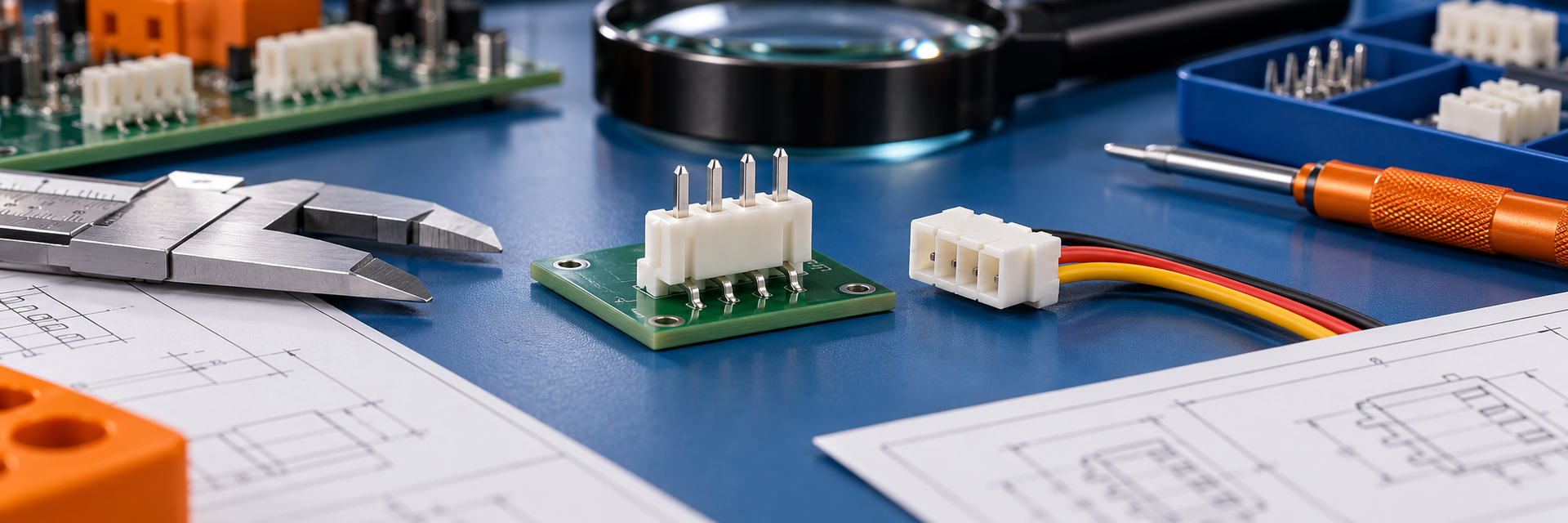
Is the generic banner an exact product image? No. It is an original documentation-review scene and deliberately avoids claiming the exact geometry of ZE05H-4P-2H.
Does a published rating approve the finished assembly? No. Ratings describe manufacturer test conditions and limits; the finished board and harness still require project-level verification.
Verified sources and related EPPTC records
First-party sources: Hirose ZE05H-4P-2H product record with its current drawings and specification links; and Hirose ZE05 series page with its current catalog link.
Technical data review: Lianxinlian Electronics Technical Data Quality Team automatically checked source reachability, language separation and internal-link completeness. This review is not a manual engineering approval and does not approve product suitability.
Conclusion: Treat ZE05H-4P-2H as a document-controlled PCB interface. Freeze the exact part and CL number, validate the footprint against Hirose's current drawing, preserve receiving traceability and verify the complete mating set before release. Keep a dated copy of the sources used for the decision, because manufacturer documents and product availability can change. When a drawing is revised, reopen the footprint review instead of assuming the previous comparison still applies. For a quotation or document check, share the exact suffix, drawing revision, board orientation and intended assembly context through the inquiry channel.