Identify KET MG631467-5 as an SDL mounting clip, distinguish catalogue categories from component function, and organize drawing and installation evidence.
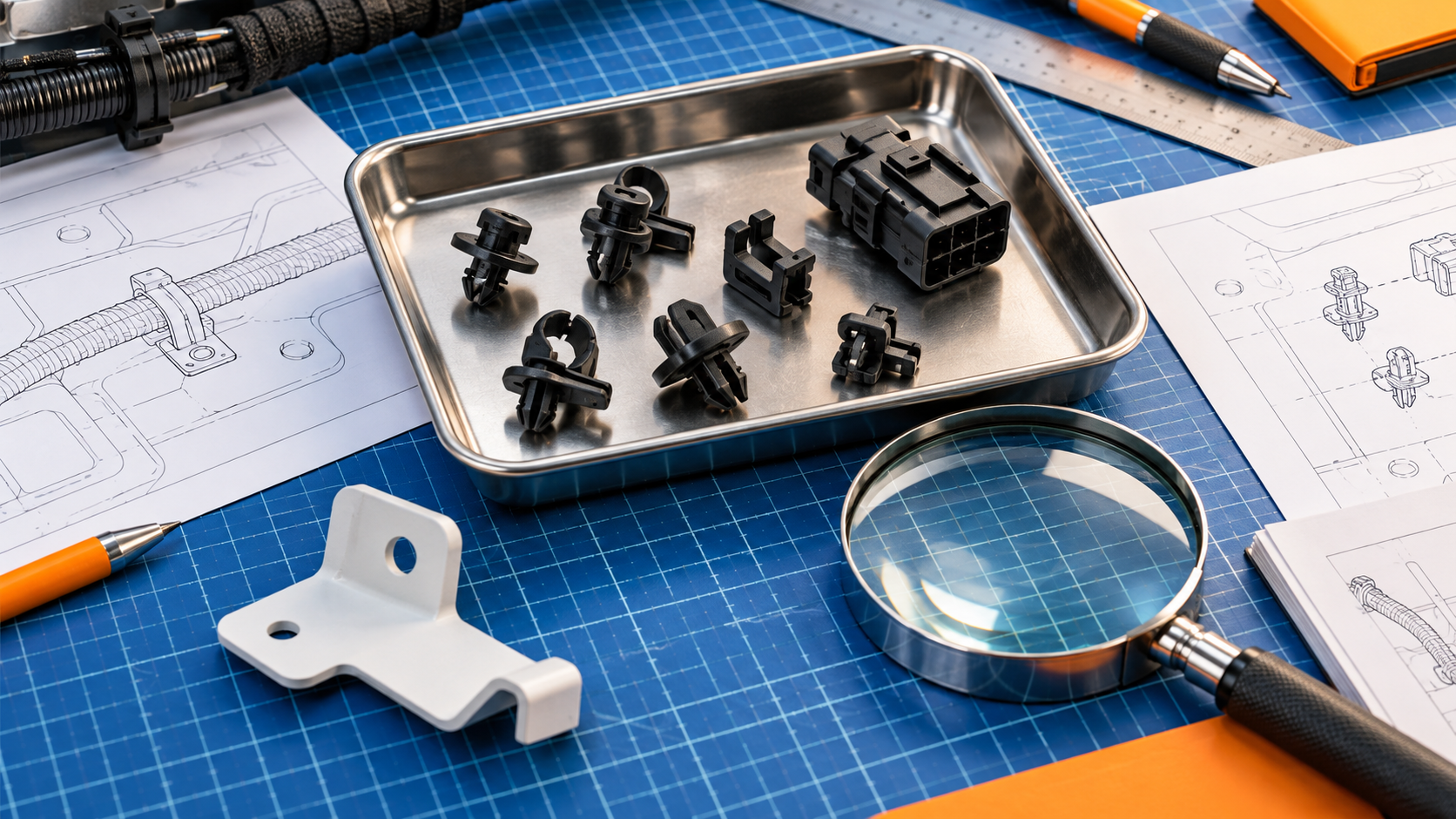
A connector enquiry can go wrong before anyone compares a dimension: the catalogue category is mistaken for the function of the item. MG631467-5 is a useful example. The EPPTC record sits in a broad housing category, while KET identifies a clip. This guide turns that difference into a practical model-identification and document handoff process. The banner illustrates generic mounting hardware and document review, rather than the exact KET component.
1. Identify the clip before building the assembly
KET places MG631467-5 in its connector sub-part clip group and associates it with SDL SERIES. Keep the full manufacturer number on the enquiry, purchase line and evidence register. A clip reference does not identify a complete electrical connector, a terminal set or a harness assembly. Ask which item is being supplied before assigning any assembly-level requirement to it.
Treat the local housing classification as a navigation label. It helps readers find the record but cannot settle its engineering identity. Preserve both observations when handing the enquiry to a colleague: the catalogue path used to find the item and the manufacturer description used to identify it. That small distinction prevents a response about a housing from silently becoming an answer about a mounting accessory.
2. Check the linked drawing and its suffix scope
The official MG631467-5 page provides a downloadable customer drawing. The title block on the retrieved sheet shows the base designation MG631467. Record that distinction rather than rewriting the drawing number to match the product suffix. The page-to-file relationship is evidence of the linked document; it does not by itself resolve every suffix-specific material, delivery or configuration question.
Save the retrieved revision with the enquiry and identify which drawing views or notes answer each question. If the project needs a suffix-specific confirmation, request it explicitly. Do not copy numerical limits from the drawing into a work instruction until the applicable item and revision have been established. This article intentionally supplies no mounting dimensions, insertion force, panel tolerance or production settings.
3. Describe the mounting interface as a project requirement
Describe the support, opening or bracket involved in the intended installation using the project drawing. Keep the clip, the supported component and the supporting structure as separate references. A related-product entry on a manufacturer page is a document-discovery lead. A finished mounting decision also needs the applicable geometry, assembly method and acceptance requirements for the actual project configuration.
Record cable routing, access for assembly and any service-removal requirements as questions for the responsible design process. If movement or environmental exposure matters, identify the required evidence and test context instead of assigning a universal capability to the clip. Where documents disagree, preserve the sample and the conflicting references. Obtain a controlled response before changing a bracket or a mounting method.
4. Use a receiving and installation document checklist
- Identity: reconcile MG631467-5 across the order, label and product record.
- Drawing: record MG631467 base designation and unresolved suffix scope.
- Interface: identify the project support and component references separately.
- Disposition: retain visible differences and assign outstanding document questions.
At receiving, retain available packaging and lot information and document visible damage or mixed material. Compare the received identity with the purchase line before discussing fit. Photographs can explain a discrepancy, while measurement requires the specified method and equipment. Keep the inspection result connected to the source used, so another reviewer can tell an observed condition from an assumed catalogue property.
A product listing does not establish current stock, price or lead time. Request a dated commercial response and keep it apart from the technical document register. Likewise, an automatic completeness check cannot approve installation suitability. The team that controls the project must resolve open interface and process questions through its established release process before production use.
5. FAQ: what can the related catalogues establish?
Does the SDL catalogue make other clips interchangeable? No. A series association helps discover records; it is not a substitute comparison. Does the automotive directory establish a vehicle application? No. The EPPTC product has a series association but no confirmed application mapping. The directory is provided for discovery, with project suitability left to the applicable evidence and responsible process.
Why do related links open English pages from the Chinese article? They are labelled direct English catalogue destinations so readers know the destination language before opening them. The Chinese article retains its own title, summary and explanation. Can the generic illustration confirm the clip shape? No. Use the exact manufacturer documents and resolve their suffix coverage rather than measuring an editorial image.
6. Conclusion: send a question that can be answered
For MG631467-5, start with the clip identity and keep the local category, exact product page and base-number drawing distinct. Send the information team the complete reference, project interface context and documents already held. That gives the recipient a useful basis for resolving the next question, while avoiding unsupported claims about fit, interchangeability or production readiness.
Official manufacturer sources
KET official MG631467-5 SDL clip product record
KET linked customer drawing, base designation MG631467; confirm suffix scope
Author: Lianxinlian Electronics Product Information Team. Technical data quality review: Lianxinlian Electronics Technical Data Quality Team automatically checks source access, language separation and internal-link completeness. This is not human engineering approval or product suitability approval.