Select TE 170360-1 by exact contact identity, drawing revision and wire configuration; separate catalogue fields from assembly and purchasing decisions.
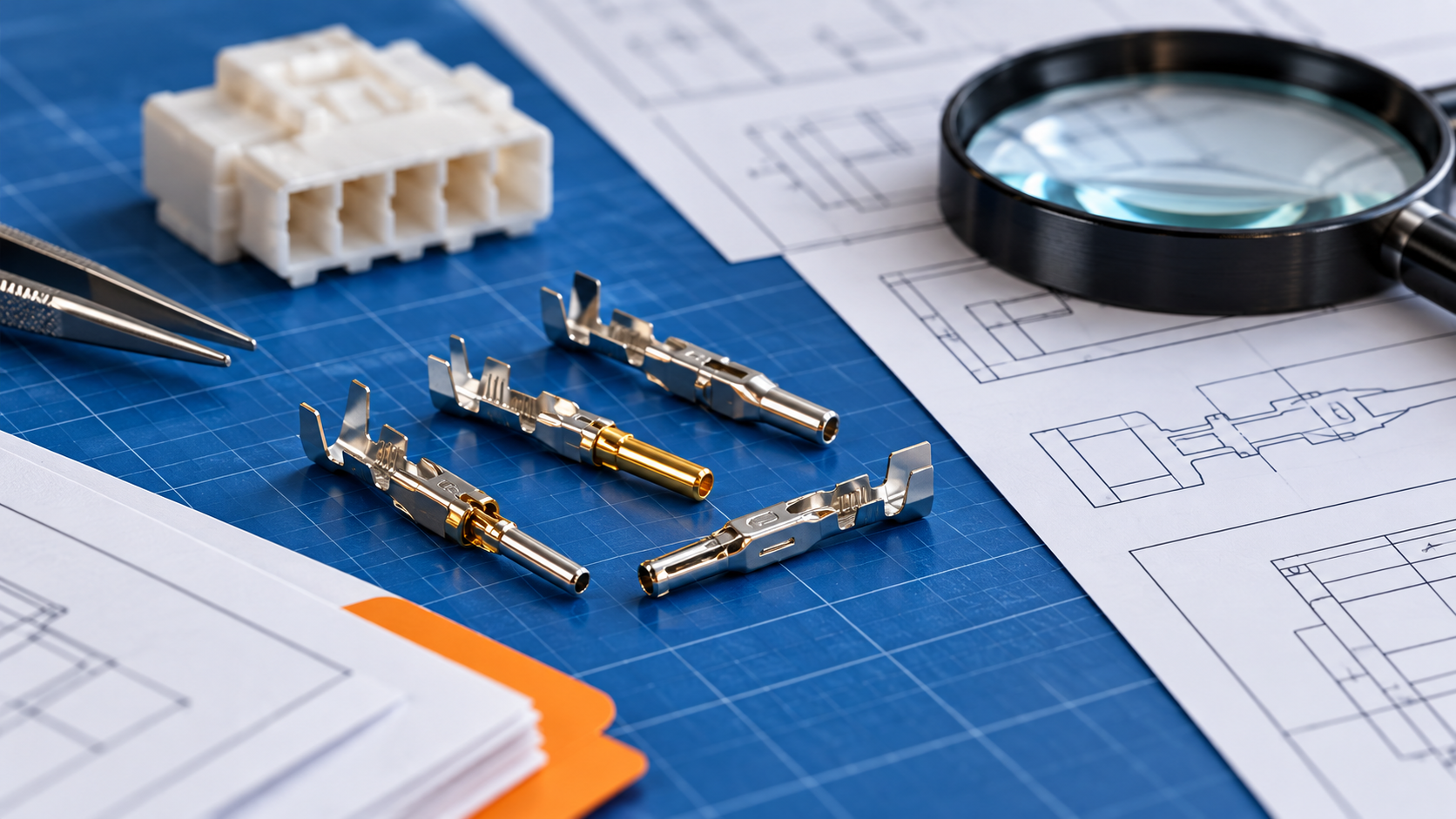
A terminal enquiry often starts with a short description such as a small power pin. That description leaves several different decisions unresolved. This guide uses the real EPPTC 170360-1 catalogue record to organize a practical selection review: identify the orderable item, find the applicable drawing and describe the intended wire configuration. The original banner shows generic contacts and document review, not an exact rendering of this TE component.
1. Establish the complete orderable identity
TE identifies 170360-1 as a Mini-Universal MATE-N-LOK pin contact with a crimp termination. That establishes a contact identity, not a complete connector assembly. Keep the full number in the enquiry and BOM, and distinguish the contact from the housing, counterpart and production tooling. A familiar family name is a useful search term, but it cannot replace the exact orderable reference.
Start a small identity register with the manufacturer number, your internal record, the package label and the source used for comparison. If the label differs, retain the difference and request clarification. Do not silently shorten the number or substitute a neighbouring suffix. A receiving photograph helps explain the discrepancy, while controlled documents and traceable responses establish what was ordered and supplied.
2. Read the drawing as a configuration document
The exact TE page links customer drawing 170360. Its table separates several orderable entries, so locate the row for 170360-1 before borrowing any detail. Record the revision actually retrieved and keep it with the project evidence pack. A drawing shared by several suffixes does not mean that every material, finish, delivery form or referenced component applies to every entry.
Use the drawing notes together with the relevant table rather than treating the page as a collection of independent numbers. When a note describes a particular configuration, preserve that condition in the evidence register. If the page and drawing appear inconsistent, log the difference and obtain a controlled answer before selecting a production setup. This guide supplies no crimp dimensions, force settings or tooling approval.
3. Separate wire requirements from catalogue limits
A wire description should include more than a nominal conductor size. Record the intended construction, insulation information, number of wires at the termination and the documents governing the assembly. Check those facts against the exact contact documents. Do not treat one catalogue field as permission for every wire sharing a nominal size, and do not assume that a special configuration note applies to an ordinary termination.
Keep the required electrical and environmental conditions in the project requirement set. Catalogue ratings describe their documented scope; they do not independently establish the performance of a finished harness. The responsible project process must resolve the complete configuration and acceptance evidence. When the wire or assembly changes, reopen the affected questions rather than carrying the previous selection forward automatically.
4. Build a selection and purchasing checklist
- Identity: retain 170360-1 and reconcile the label with the enquiry.
- Documents: record the exact source, revision and relevant drawing entry.
- Configuration: list wire, housing, counterpart and tool references separately.
- Open questions: assign each missing document or unresolved difference an owner.
Send the checklist with the current BOM and available manufacturer documents. Make proposed changes visible so the recipient can see which requirements are fixed and which are still being discussed. A clear request avoids a common purchasing mistake: accepting a reply about a family as though it answered an exact-part question. Keep the original request and subsequent response together for later change review.
Commercial availability needs a current quotation. A public product record does not promise stock, price, lead time or order packaging. Likewise, a supplier response and a manufacturer drawing are different evidence types. Record what each source actually establishes and avoid rewriting a commercial answer as a technical acceptance decision. This article makes no substitute or compatibility determination.
5. FAQ: use the related catalogues carefully
Does the series page select the housing or counterpart? No. It helps discover records; the exact configuration still needs its applicable documents. Does the wire-to-wire directory prove an application for this contact? No. EPPTC has a real series association but no confirmed application mapping for this product. That directory is a browsing aid, not an application approval or an interchangeable-parts list.
Can an image settle the exact finish or production method? No. Use the applicable controlled item record. Related links in both language versions open direct English catalogue and contact pages, as the navigation heading states. The Chinese article has its own localized title, summary and technical explanation; the destination-language label simply tells readers what to expect after opening a related record.
6. Conclusion: make the selection traceable
For TE 170360-1, begin with exact contact identity and retain the drawing context before comparing wire or assembly choices. Send the product information team the full reference, intended configuration and documents already held. Automatic technical data quality review checks source access, language separation and internal-link completeness. It does not replace the responsible project decision or provide human engineering approval.
Official manufacturer sources
TE official 170360-1 product record
TE customer drawing 170360, exact part table and configuration notes
Author: Lianxinlian Electronics Product Information Team. Technical data quality review: Lianxinlian Electronics Technical Data Quality Team automatically checks source access, language separation and internal-link completeness. This is not human engineering approval or product suitability approval.