Use the official TE 2387544-2 record to organize terminal identity, missing documents and selection questions before connector assembly or purchasing handoff.
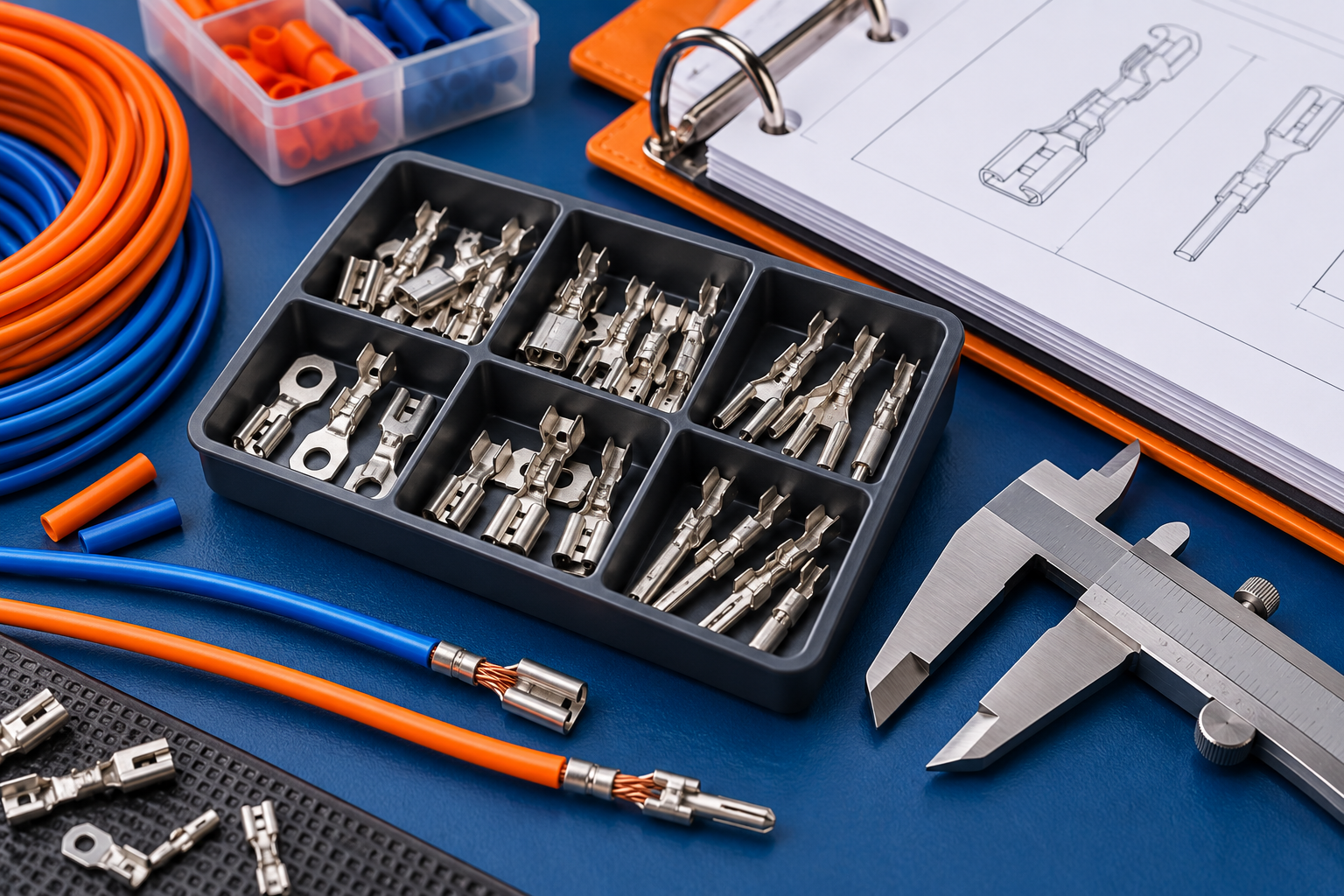
A terminal enquiry often starts with a part number and a proposed harness. The useful next step is to establish what the available documents actually support. This guide uses the real EPPTC 2387544-2 record and the publicly readable TE product page to build a selection checklist. The banner depicts a generic terminal-document inspection scene; it does not claim to reproduce this part’s geometry.
1. Preserve the complete manufacturer identity
The official TE page identifies 2387544-2 and presents a 0.64 SERIES terminal description. It also warns that the displayed product information may be incomplete and directs readers to contact TE for documentation or compatibility questions. Keep that warning with the identity record. A readable manufacturer description is a useful source anchor, but it is not a complete assembly specification.
Retain the entire number, including the suffix, in the enquiry, BOM and received-label record. If a supplier offers another suffix or a shortened number, treat it as a separate candidate until its identity is established. Do not infer plating, dimensions, wire range or an interchangeable part from neighbouring numbers. The comparison needs documents tied to each actual orderable record.
2. Separate catalogue facts from missing evidence
Create a small evidence register with three states: verified, requested and unresolved. For each entry, record the source URL or document identifier, its revision when available and the question it addresses. A blank field should remain an open question rather than becoming a default value. This prevents a preliminary sourcing note from quietly turning into a manufacturing requirement.
The terminal description alone does not establish the selected housing, mating component, conductor construction or production tool. Ask for the exact drawing and applicable process documents before making those decisions. Record whether the response concerns 2387544-2 specifically or only a wider family. A family reference can help discovery while leaving the exact configuration unresolved.
3. Prepare an assembly-specific document request
Describe the intended assembly so that the manufacturer or responsible project process can answer a bounded question. Include the proposed housing number, wire construction, intended production method and installation requirements. Keep assumptions visibly separate from released requirements. The objective is a traceable response for a specific assembly, rather than a broad statement that a terminal is suitable for any harness.
A drawing may answer geometry questions without providing all manufacturing settings. Likewise, a catalogue entry may identify a terminal without validating the selected wire and tool combination. Keep each decision tied to its appropriate document and project disposition. This article gives no crimp dimensions, force limits, electrical ratings, sealing class or approved substitute because those facts have not been established here.
4. Use a clear receiving and handoff checklist
A practical handoff packet should allow another reader to reconstruct the identity check and see every remaining question. Include the original enquiry, actual response and any relevant label photographs. Receiving staff can document observed identity and packaging traceability while engineering retains responsibility for configuration and process decisions. A photograph is evidence of an observation, not a performance test.
- Identity: retain 2387544-2, its manufacturer reference and received-label evidence.
- Documents: list the exact drawing, revisions and unresolved process requests.
- Assembly: identify the proposed housing, wire, mate and tooling separately.
- Changes: reopen affected checks when a suffix, document or assembly item changes.
Keep commercial questions in the current quotation. The existence of a public product page does not establish stock, price, delivery time or a reserved quantity. If identity is unresolved, preserve the discrepancy and seek a documented answer rather than silently accepting a similar label. Link the final disposition to the relevant lot and enquiry so that later changes remain traceable.
5. FAQ: family names and compatibility claims
Does the 0.64 SERIES description prove a mating combination? No. Resolve the exact housing and interface records before selecting an assembly. Can a similar-looking terminal replace 2387544-2? This guide establishes no substitution. A proposed alternative needs its own controlled comparison. Does the official page provide a complete process specification? Its incompleteness warning means further documents may be required.
EPPTC currently has no confirmed series or application mapping for this exact record. The automotive directory below is a discovery link, not a claim that 2387544-2 is approved for a vehicle location. The automatic editorial review checks source access, language separation and link completeness. It does not certify the terminal or perform human engineering approval of the proposed assembly.
6. Conclusion: resolve the gaps before selection
Start a 2387544-2 selection enquiry with the exact manufacturer identity and preserve the limits of the available product page. Send the intended assembly details and an explicit list of missing documents with the request. Keep the response attached to the relevant configuration and let the responsible project process decide the next step using actual evidence. Clear open questions are more useful than an unsupported compatibility statement.
Official manufacturer source
Author: Lianxinlian Electronics Product Information Team. Technical data quality review: Lianxinlian Electronics Technical Data Quality Team automatically checks source access, language separation and internal-link completeness. This is not human engineering approval or product suitability approval.