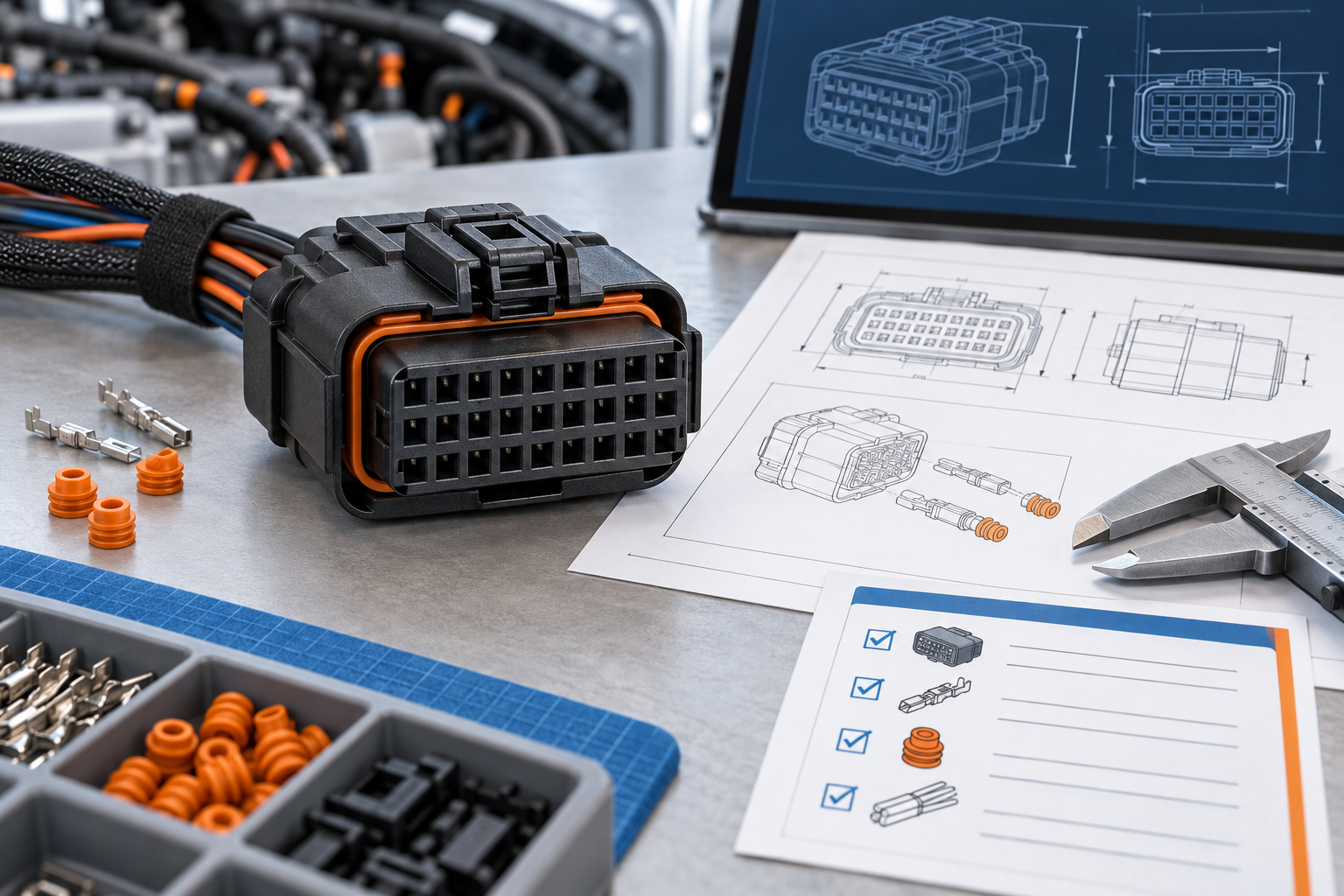
Summary: TE Connectivity 1-2278915-4 is documented as a 30-position sealed automotive housing for female terminals in the MQS family. A dependable selection review should confirm the complete part identity, read the customer drawing before interpreting interfaces, and keep assembly requirements separate from catalogue discovery. This guide organizes that evidence without claiming stock, substitute parts, or compatibility that the manufacturer documents do not establish.
Start with the exact 1-2278915-4 identity
The EPPTC product record and TE documentation identify 1-2278915-4 as a cable-mounted automotive connector housing. The manufacturer record describes a two-row, 30-position housing for female terminals, intended for a sealed wire-to-board context. Those attributes are useful for classification, but the full part number remains the controlling identity. A family name such as MQS, a cavity count, or a similar photograph is not enough to release a purchase or assembly.
Preserve every hyphen and suffix when the number moves through an RFQ, BOM, incoming label, drawing register, and work instruction. Record the document number, revision, retrieval date, and project owner alongside the material number. If an ERP description or supplier quotation abbreviates the part, resolve the difference before treating the records as the same item.
Read the product drawing before mapping interfaces
TE customer drawing 2278915 is the primary reference for part-controlled geometry, views, notes, and revision history. Use the drawing to verify orientation, cavity layout, datum references, keying features, and the assembly elements shown for the exact variant. Dimensional inspection should follow the drawing’s defined features and tolerances rather than measurements inferred from a web image.
The drawing may show related components or assembly context, but that does not authorize a broad compatibility statement. Copy any referenced part number exactly and confirm that it applies to the current dash number and revision. If a proposed header, terminal, seal, cover, or accessory is absent from controlled evidence, leave the relationship open instead of filling the gap with a reseller cross-reference.
Use the application specification for process context
Application specification 114-18604 provides the controlled process context associated with this connector system. Review the current document before defining preparation, terminal loading, secondary-lock handling, mating, inspection, or rework steps. A product drawing explains the part; an application specification explains how a defined system is processed. Neither should be replaced by a short catalogue description.
Translate the applicable requirements into the project’s own work instruction with traceable citations. Keep tooling identifiers, conductor preparation limits, inspection criteria, and change status visible. Where the specification refers to other controlled documents, retrieve those documents rather than guessing from common connector practice.
Selection and assembly documentation checklist
- Match the complete TE Connectivity number 1-2278915-4 across the BOM, drawing, label, and receiving record.
- Record customer drawing 2278915 and application specification 114-18604 with their current revisions.
- Confirm the documented 30-position, two-row housing identity before comparing physical samples.
- Verify every terminal, seal, header, and accessory relationship from controlled manufacturer evidence.
- Use the applicable specification and released work instruction for loading, locking, mating, and inspection.
- Separate technical identity from commercial questions such as availability, package quantity, lead time, and price.
An evidence matrix makes the handoff auditable. Give each claim one row with the exact source, revision, owner, and status. Mark unresolved interfaces explicitly. This prevents a valid family-level observation from being mistaken for approval of a particular assembly.
Common questions about the MQS housing
Does the MQS name prove that another component fits?
No. The series index helps discovery, but fit and use must be supported by the exact drawing, application specification, or another controlled TE record for the relevant part numbers.
Can position count and color identify the housing?
They are supporting observations only. Confirm the full material number and drawing-controlled geometry. Similar-looking housings can differ in keying, interface details, materials, or revision status.
Does this article approve a production assembly?
No. It is a documentation workflow. Product suitability, tooling release, process parameters, validation, and acceptance remain with the project’s authorized engineering and quality controls.
TE Connectivity first-party sources
- TE Connectivity customer drawing 2278915 — controlled product views, dimensions, notes, and revision context for 1-2278915-4.
- TE Connectivity application specification 114-18604 — controlled process and application context for the documented connector system.
Related EPPTC records
Authorship and technical-data review
Author: Lianxinlian Electronics Product Information Team.
Technical-data review: Lianxinlian Electronics Technical Data Quality Team checked source accessibility, language separation, internal-link coverage, and structured-data completeness. This automated documentation-quality review is not a human engineering approval, compatibility decision, or product-suitability authorization.
Conclusion
For TE Connectivity 1-2278915-4, anchor the review to the exact part number, use drawing 2278915 for product-controlled details, and use specification 114-18604 for process context. Keep family navigation, component relationships, commercial availability, and project approval as separate decisions. If an interface or revision remains unclear, submit the complete material and document references to EPPTC before release.